After spending a few days in Tokyo, we were off to our next destination on our journey across Japan, Kyoto. The quickest and easiest way to get between cities on Honshu, the main island of Japan where Kyoto, Osaka, and Tokyo are located, is via the Shinkansen.
This was one of the portions of the trip that I was most looking forward to as the Japanese high speed rail network is one of the oldest and most advanced in the world.
Booking Our Shinkansen Trip
The most difficult part of our journey was booking our tickets. Tickets can be booked at the station but, given the fact we were traveling during a busy tourism period and with a lot of luggage, we wanted to ensure we had seats together.
After fumbling various websites and guides, I finally found the smartEx App which was the easiest way to book tickets. After booking our tickets, I received a confirmation email but no tickets. In the email was a code which I had to go back and use to pull my tickets in the app.
Boarding Our Shinkansen Train
Things in Japan, especially the trains, operate extremely timely. Our train to Kyoto was scheduled to depart at 10:00a and we arrived at Tokyo Station 15 minutes before departure. This was more than enough time as we managed to grab a snack from one of the convenience stores for the ride before heading up to the platform 10 minutes before departure.

Our train was departing at 10:00a and, since Tokyo is the terminus of the Tokaido Shinkansen, our train was already waiting in the station. We headed onboard for the quick, two hour trip down to Kyoto.
Tokaido Shinkansen
Nozomi 231
Tokyo-Kyoto (Tokyo – Kyoto)
Seat: 3A (ordinary)
N700A
Scheduled: 10:00a-12:15p
Actual: 10:00a-12:15p

Between Kodama (Slowest, all-stops), Hikara (fewer stops than the Kodama), and Nozomi (Super Express), there are trains departing on the line from Tokyo every few minutes.
Tokaido Shinkansen Ordinary Car Seating
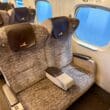
Our seats were located in Car 13, an Ordinary Car (think Coach or 2nd Class) towards the rear of the train. Seats on the train are arranged in a 3-2 layout. These seats were no frills and definitely on the older side but they were extremely clean and well maintained.


Since there are five seats per row and there were four of us in the group, I assigned us seats 3A, 3C, 3D, and 3E. This left the middle seat empty and, we locked out as it stayed empty for the entire trip to Kyoto. Legroom in the ordinary car was great and I had plenty of space to spread out during the journey.

A tray table and a small storage pocket were located on the back of the seats in front of us. The tray table was a decent size and I could place a laptop and beverage here at the same time if needed, though the laptop needed to be at an angle.


The seatback pocket was small but could hold a book, snacks, or even a small bag, making it a great place for us to keep snacks during the journey.

Under the seats, along the wall, are power outlets. This meant that only the window seats had access to power.

As we settled in I noticed that the train was a bit warm and there weren’t any individual air nozzles at the seats. This was the only knock I had on the train vs. an airplane.
Our Trip
As expected, our train pulled out of Tokyo Station right on schedule and headed south towards Kyoto.


We made a quick stop in the southern part of Tokyo at Shinagawa Station and then at Shin-Yokohama station. From there the hustle and bustle of the city fell away and the scenes out of the window became more and more rural.

While the views out of my window were nice, if you’re heading southbound I’d recommend sitting on the right side of the train. From here you get great views of the mountains and, on a good weather day, you can see Mt. Fuji in the distance.
After roughly 30 minutes on the train I broke out the snacks that we brought on board; a sandwich and an Asahi beer. This was important as there is no buy on board service for ordinary car passengers. Trolley service was available but it was removed in 2023.

I passed the majority of the time working and looking out the window as the Japanese countryside whizzed by. Even though the train was moving in excess of 150 miles an hour, it was extremely smooth. The only time I noticed it was when I was walking along the train in a curve, but the sensation was minor.
After an hour I decided to and check out the lavatory. It was a decent size, especially compared to a plane, but much much smaller than I have seen on high speed trains throughout Europe.

There was also a smoking area near the lavatory though Japan Railways sealed these off back in 2024. It has a window that one can look through and none of the items on this train had been removed, so it was like looking back in time.
Arrival
After an extremely fast and efficient journey, we pulled into Kyoto Station right on schedule. We got a quick glimpse at our train as it headed south towards Osaka before stashing our luggage in one of the station’s lockers before heading out to explore the city.


Summary
While this was an extremely cool experience, I was a little surprised by how low frills the Shinkansen was. On one hand this mode of transportation is meant to transport passengers as quickly and efficiently as possible, but the lack of any sort of buy on board food for Ordinary Car passengers was a bit of a head scratcher.